

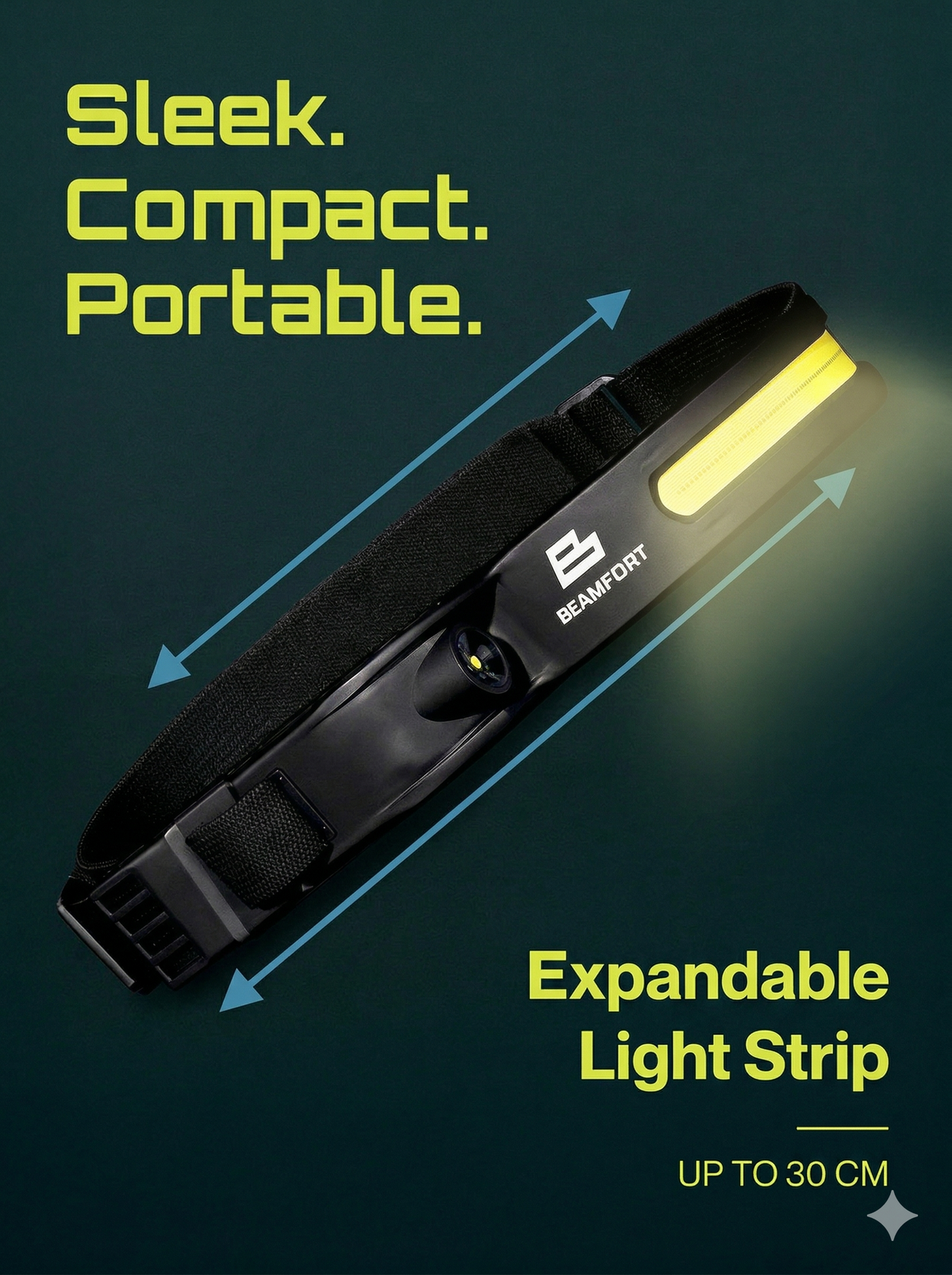
A rechargeable headlamp can run for a few hours or well over a full day on one charge—the answer depends mainly on the light mode you use. On the Beamfort Pro COB Headlamp, published runtimes range from about 2.5 hours on the 500-lumen COB high setting to about 36.5 hours on the 15-lumen SMD low setting.
The useful question is not simply “How long does a headlamp last?” It is “Which setting gives me enough light for this task without using more battery than I need?” This guide explains how to read runtime specifications, choose a practical mode, and charge and store a rechargeable headlamp responsibly.
Beamfort headlamp runtime by mode
The Beamfort Pro COB Headlamp uses a 2000mAh rechargeable 18650 lithium-ion battery and offers four white-light settings. The wide COB flood and the separate SMD spotlight do not operate together.
| Mode | Output | Published runtime | Useful for |
|---|---|---|---|
| COB high | 500 lumens | About 2.5 hours | Brief high-output work and surveying a dark area |
| COB low | 150 lumens | About 6.5 hours | General close-range work and broad area lighting |
| SMD high | 55 lumens | About 15 hours | Focused inspection when modest output is enough |
| SMD low | 15 lumens | About 36.5 hours | Low-level, long-duration visibility |
These are mode-specific figures, not a promise that every charge will produce exactly the same result. Runtime can vary with usage patterns, battery condition, charging, and operating conditions.
Why maximum lumens do not tell you runtime
A maximum-lumen number describes the brightest available setting, not how long the light will operate at every setting. Higher output draws more energy, which is why the 500-lumen COB high mode has a much shorter listed runtime than the lower-output modes.
This tradeoff is normal across portable lighting. A useful headlamp gives you more than one level so you can reserve maximum output for the moments that need it. If you are working at arm's length inside a cabinet or organizing gear at a campsite, a lower flood setting may provide sufficient visibility while extending the time between charges.
Choose the beam before choosing the brightness
Runtime planning starts with beam shape. A broad flood spreads light across the near work area, while a spotlight concentrates it in a smaller area and reaches farther. Choosing the wrong beam can tempt you to increase brightness unnecessarily.
- Use the COB flood when you need to see a bench, engine bay, cabinet, trail area, or campsite around you.
- Use the SMD spotlight when you need to inspect a more distant or specific point.
- Start on the lower setting and increase output only if you cannot see the detail you need.
For more examples, read our comparison of flood beams versus spotlights.
Plan runtime around the task, not the shift
You may be away from a charger for eight hours without needing eight hours of continuous high-output light. Break the task into lighting periods instead:
- Survey: use high output briefly to understand the space and identify hazards or work points.
- Work: switch to the lowest setting that gives clear visibility at the actual working distance.
- Inspect: use the appropriate flood or spot setting for the final check.
- Turn off: use motion-sensor control or the regular controls when light is not needed.
For a long service call, camping trip, or outage kit, a second independent light also prevents one depleted device from leaving you in the dark. The Beamfort Pocket Light is a USB-C rechargeable companion with white task lighting and warm yellow lighting in a slim aluminum-alloy body.
How to charge a rechargeable headlamp safely
The Beamfort Pro COB Headlamp charges through USB-C. Follow the product instructions and use a compatible charging source. Do not assume that any cable or power adapter is appropriate simply because the connector fits.
Health Canada's lithium-ion battery guidance recommends charging devices at room temperature where you can see them, away from soft surfaces that can trap heat. It also advises against using batteries that are swollen, dented, damaged, or showing other signs of wear.
For sensible day-to-day care:
- inspect the headlamp, charging port, and cable before charging;
- keep the device dry while charging;
- charge on a firm, clear surface rather than a bed or couch;
- follow the supplied instructions and avoid charging longer than recommended; and
- stop using the device if you notice swelling, unusual heat, damage, or a persistent unusual smell.
How to store a rechargeable headlamp
Storage matters most when a headlamp sits in a vehicle, emergency kit, tool bag, or seasonal camping bin. Health Canada advises storing lithium-ion batteries at room temperature in a dry location and not leaving them in a hot or cold vehicle.
Before storage, make sure the light is dry and the controls cannot be pressed accidentally by other gear. Check and recharge stored emergency lighting on a regular schedule appropriate to how often you rely on it. A calendar reminder is more dependable than discovering a depleted light during an outage or roadside problem.
What runtime should you look for?
Choose runtime based on the brightness and beam you will actually use. A long low-mode figure is valuable for extended visibility, but it does not replace enough output for detailed work. Likewise, a high maximum output is useful only if its runtime covers the periods when you genuinely need that brightness.
For most buyers, the best specification is a clear mode-by-mode runtime table. It lets you match high output to short demanding tasks, lower output to routine work, and a focused beam to longer inspection periods. That is a more reliable way to choose a rechargeable headlamp than comparing maximum lumens alone.
Best Headlamp for Plumbers: Lighting Tight, Wet Workspaces
How to Light an Engine Bay for Repairs and Inspections