

If you have to set up camp after dark, the most useful lighting plan is simple: wear a headlamp for moving and assembling gear, place a second light where shadows form, and postpone nonessential setup until daylight. Keeping both hands free matters more than flooding the entire campsite with maximum brightness.
Late arrivals happen because of traffic, weather, long driving days, or slower-than-expected trails. A little preparation can make the necessary setup faster, quieter, and easier to manage.
Pack your lights where you can reach them first
A light buried beneath sleeping bags and cooking gear is not much help when you arrive at a dark site. Before leaving home, place your primary headlamp in an exterior pocket, glove box, door compartment, or top section of your pack.
Keep the charging cable and any backup light together in one small pouch. That prevents a late-night search through multiple bins and makes it easier to confirm that everything is charged before departure.
Use a headlamp as your primary setup light
Pitching a tent, connecting poles, carrying gear, and locating stakes all require two hands. A headlamp directs light where you look without asking someone else to hold a flashlight.
For close-range campsite work, a broad flood beam is especially useful because it illuminates more of the area around your hands. The Beamfort Pro COB Headlamp uses a 230° COB flood beam and provides up to 500 lumens. It also includes a separate SMD spotlight when you need a more focused view farther from the immediate work area.
The flood and spotlight are separate modes. Choose the beam that matches the task rather than expecting both to operate simultaneously.
Start with only the essential setup
When everyone is tired and visibility is limited, simplify the plan. Complete what you need for a comfortable night and leave decorative or optional setup for the morning.
A practical order is:
- Confirm that you are at the correct campsite.
- Identify the flattest suitable tent area and nearby obstacles.
- Set up the tent or sleeping area.
- Bring out sleeping gear and essential personal items.
- Secure food according to the campground or area rules.
- Organize only the lighting and supplies needed overnight.
Chairs, elaborate cooking stations, and other nonessential equipment can usually wait until daylight.
Match brightness to the task
Maximum output is useful when first checking an unfamiliar area, but it is not necessary for every step. Lower output can reduce glare from tent fabric, vehicle paint, reflective gear, or nearby surfaces while extending runtime.
The Beamfort Pro’s verified white-light settings and approximate runtimes are:
- COB high: 500 lumens for about 2.5 hours
- COB low: 150 lumens for about 6.5 hours
- SMD high: 55 lumens for about 15 hours
- SMD low: 15 lumens for about 36.5 hours
Use high output to assess the area, then switch to a lower setting for close work when it provides enough visibility. Runtime depends on the selected mode, so plan around the setting you expect to use—not only the longest published number.
Add a second light to control shadows
A headlamp shines from approximately the same direction as your eyes. When your hands, arms, tent fabric, or gear block that beam, the work area can fall into shadow.
A second light placed to the side creates another angle. The Beamfort Pocket Light can be carried with its integrated clip or positioned on a compatible metal surface using its bottom magnet. It offers white and warm/yellow light, USB-C charging, and up to 500 lumens from its compact 5 W light.
The Pocket Light’s approximate runtime is two to five hours depending on the selected mode, with an approximate USB-C charging time of two to three hours.
Assign jobs before everyone starts moving
A small group can work more efficiently when each person has a clear task. One person can handle the tent body, another can assemble poles, and another can move sleeping gear or keep essential items together.
If only one light is available, the person performing the most hands-on assembly should usually wear it. With two lights, keep one on the main task and use the second to illuminate gear or the entrance area.
Be considerate with light around other campers
A very bright beam aimed across neighboring sites can be disruptive. Angle the light toward the ground and immediate work area whenever possible. Use only the brightness needed for the current task, especially if you arrive late.
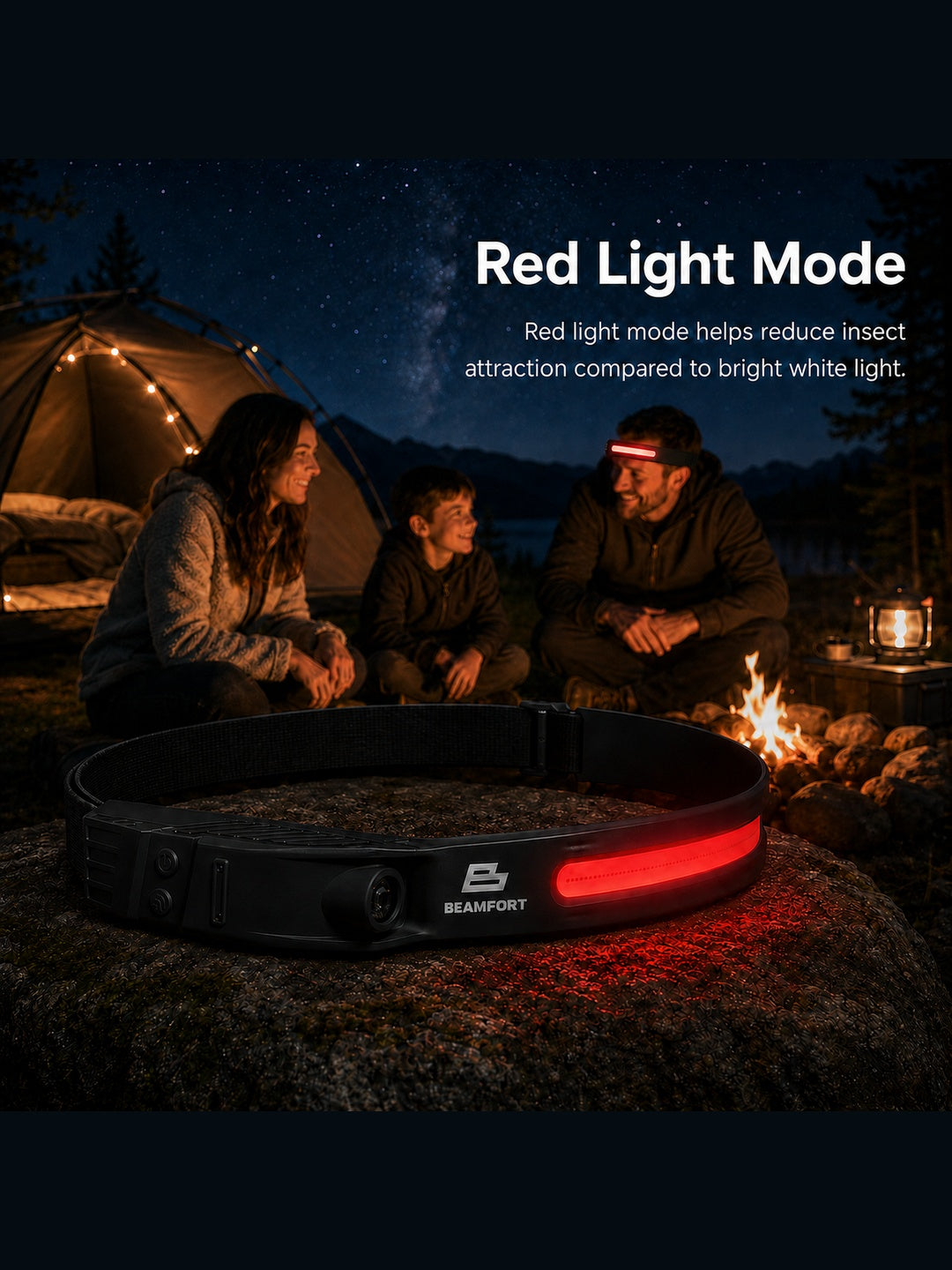
The Beamfort Pro also includes red and strobe modes, but neither should be represented as regulated emergency signaling. At camp, select modes based on practical visibility and consideration for the people around you.
Plan for rain and splashes
Outdoor lights should be used according to their published water-resistance rating. The current Beamfort product pages list IPX4 water resistance for both the Pro COB Headlamp and Pocket Light, meaning they are intended to handle ordinary splashes and rain exposure—not submersion.
Keep charging ports closed when the lights are in use, and allow wet equipment to dry before charging.
Recharge before the return trip
The Beamfort Pro uses a 2000 mAh rechargeable 18650 lithium-ion battery and charges through USB-C. The Pocket Light also recharges through USB-C, so both can fit into the same general charging routine with compatible equipment.
For multi-night trips, use the lower mode that comfortably handles the task and recharge from a suitable power source when available. Check both lights before the drive or hike home instead of discovering an empty battery during the next late arrival.
After-dark campsite lighting checklist
- Primary headlamp charged and easy to reach
- Secondary light packed with the primary light
- USB-C charging cables stored together
- Brightness lowered after the initial site check
- Beam directed toward the immediate work area
- Essential setup completed before optional equipment
- Food stored according to local campground or wilderness requirements
- Lights checked again before the return trip
The practical setup
A headlamp should handle movement and assembly because it keeps your hands available and follows your line of sight. A compact secondary light should fill shadows or remain fixed on a specific part of the campsite.
If you are deciding how to divide those roles, our guide to headlamps versus pocket work lights explains the underlying difference between a light that follows your eyes and one that stays where you place it.
Explore the Beamfort Pro COB Headlamp and the Beamfort Pocket Light for a rechargeable two-light campsite setup.
How to Choose a Headlamp for Dog Walking at Night
Power Outage Lighting: How to Prepare Your Home